Water & Life Intelligence · Indus Basin

Pakistan is ranked one of the world's most climate-vulnerable countries. The same terrain that makes it vulnerable is where restoration would carry furthest. Damage and leverage share the same coordinates.

Ranked #1 on the 2025 Climate Risk Index. $15B in 2022 flood damages alone. The same storms bypass a terrain that stopped being able to catch them.

45

Years of ERA5 record behind the physics

8

Intelligence layers, one convergence map

5

Countries in active fieldwork

Indus Basin · Layer View
LIVE
KARAKORAM HINDU KUSH SALT RANGE SULAIMAN KIRTHAR INDUS JHELUM CHENAB RAVI SUTLEJ MURREE / AYUBIA CHANGA MANGA KIRTHAR FOREST WHEAT RICE COTTON SUGARCANE PUNJAB RICE BURN ~14M t · OCT–NOV CHOLISTAN THAR BALOCH PASTORAL NILI-RAVI DAIRY KARACHI LAHORE FAISALABAD MULTAN ISLAMABAD TRIGGER POINTS
Convergence Where all five layers point to the same coordinates. That is where one action compounds into five outcomes. That is the site.
Published research · 45-year ERA5 record · Active in Pakistan · Spain · Portugal · Jordan · Colombia · Preprints pending review
What Becomes Possible

Climate risk platforms see damage. LandIQ sees the restoration opportunity inside it.

The intel layer for governments, multilaterals, and the capital that funds water, restoration, and carbon projects. When pressures converge in the same district, interventions stop being scattered — they start compounding.

01See the mechanism
02Site the intervention
03Compound the outcome

Every project lands at the right site

No more guesswork. No more picking sites by availability or politics. When you can see where multiple pressures and opportunities overlap, every dollar, every tree, every tonne of biochar goes exactly where it does the most.

One intervention. Five outcomes.

A district with high fertilizer costs, available crop residue, and declining water tables is not three problems. It is one site where biochar cuts input costs, builds soil, and restores water. The overlap is the leverage.

Recovery travels.

The same tight coupling that lets degradation cascade through a landscape can be reversed. Restore the right site and the effects travel: downstream water quality improves, adjacent farms see moisture return, the atmospheric signal shifts.

Pakistan

A country where collapse and restoration share the same map.

Pakistan is not short on data, money, or people who care. It is short on a view that shows where all of these meet. The crises are real. So is the opportunity hidden inside them.

90%

Water consumed by agriculture

Pakistan uses more water per hectare than almost any country in its income bracket. Efficiency gains in agriculture are water gains for everyone.

$2.5B

Annual fertilizer import bill

Farmers in high-input districts spend PKR 12,000-18,000/acre on synthetic fertilizer. Every rupee exposed to exchange rate risk and commodity swings.

14M

Tonnes of crop residue burned yearly

Rice straw in Sindh and Punjab. Sugarcane tops in lower Punjab. Feedstock for biochar, compost, and energy, set on fire every harvest.

33M

People displaced by the Indus floods

The same Indus floodplain that grows Pakistan's food absorbed a catastrophic flood. Recovery siting needs spatial intelligence, not guesswork.

The Mechanism

One valve. Five ridges. A cascade waiting to restart.

Between the Arabian Sea and K2, Pakistan's terrain intersects five successive condensation stages. A single atmospheric variable, the lifting condensation level, decides how many are active. Across 45 years of ERA5 reanalysis, the answer is two. The other three are not blocked by geography. They are compressed by a missing land surface. That compression can be released.
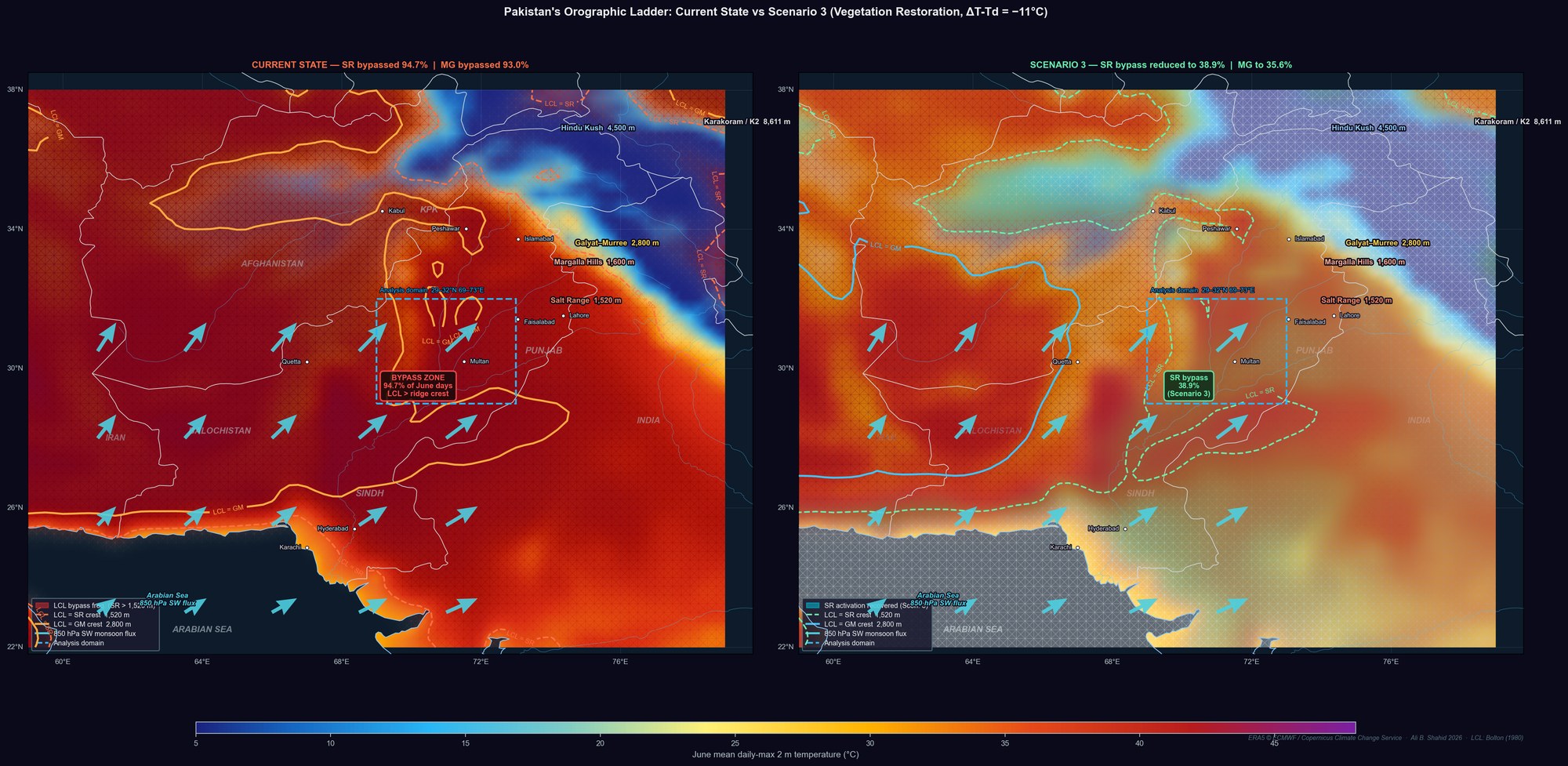
Current state vs Scenario-2 restored state — side-by-side LCL bypass comparison across Pakistan
The outcome · current state vs restored cascade Left: current state. Right: Scenario 2 — an −8°C dewpoint-depression recovery applied to the same 45-year ERA5 record. The Salt Range bypass falls from 94.7% to 56.9%; the lower orographic stages rejoin the cascade. The mechanism is not a prediction. It is a lever with a measured output.
Salt Range Bypass
94.7%
Of pre-monsoon days, moisture passes above the 1,520 m ridge crest instead of condensing on it.
Indus Plains LCL · June
2,727 m
Daily-maximum lifting condensation level: 1,207 m above the Salt Range. The first three stages are aerodynamically transparent.
Restoration Lever
−55 pts
ET-driven dewpoint recovery (15.5 °C → 4.5 °C depression) lowers peak LCL to 1,358 m, cutting Salt Range bypass from 94.7% to 38.9%.

The gap between Pakistan's current water capture and its terrain-defined ceiling is the largest unrealized natural capital endowment in South Asia. Closing it is a water-security, food-security, and climate-resilience problem solved by the same intervention.

ERA5 1980–2024 · Indus Plains domain 29–32°N, 69–73°E · LCL approximation cross-validated against Romps (2017), mean bias 3 m.
Full methodology: Biome-specific radiative forcing coefficients (Shahid 2026, Zenodo DOI) · Paper 1 pollen–light-rain (complete) · Paper C orographic ladder (working paper).
The Layers

Eight questions. One answer.

Each layer is a spatial question with a spatial answer. Select one to read what that answer looks like, per district, per season.

Intelligence Layers
01
Geophysical
02
Water
03
Biosphere
04
Farming
05
Feedstock
06
Livestock
07
People
08
Convergence
LAYER 06 · CONVERGENCE

The hinge, not the whole basin.

Where do all seven answers point to the same coordinates?

One action. Five outcomes. It is a spatial operation, not a metaphor. The district where water stress, farming cost, feedstock waste, livestock pressure, and community readiness overlap is the site where a single intervention compounds into systemic recovery.
7
Zones mapped
Indus
Basin focus
A Sample Run

What a single run looks like.

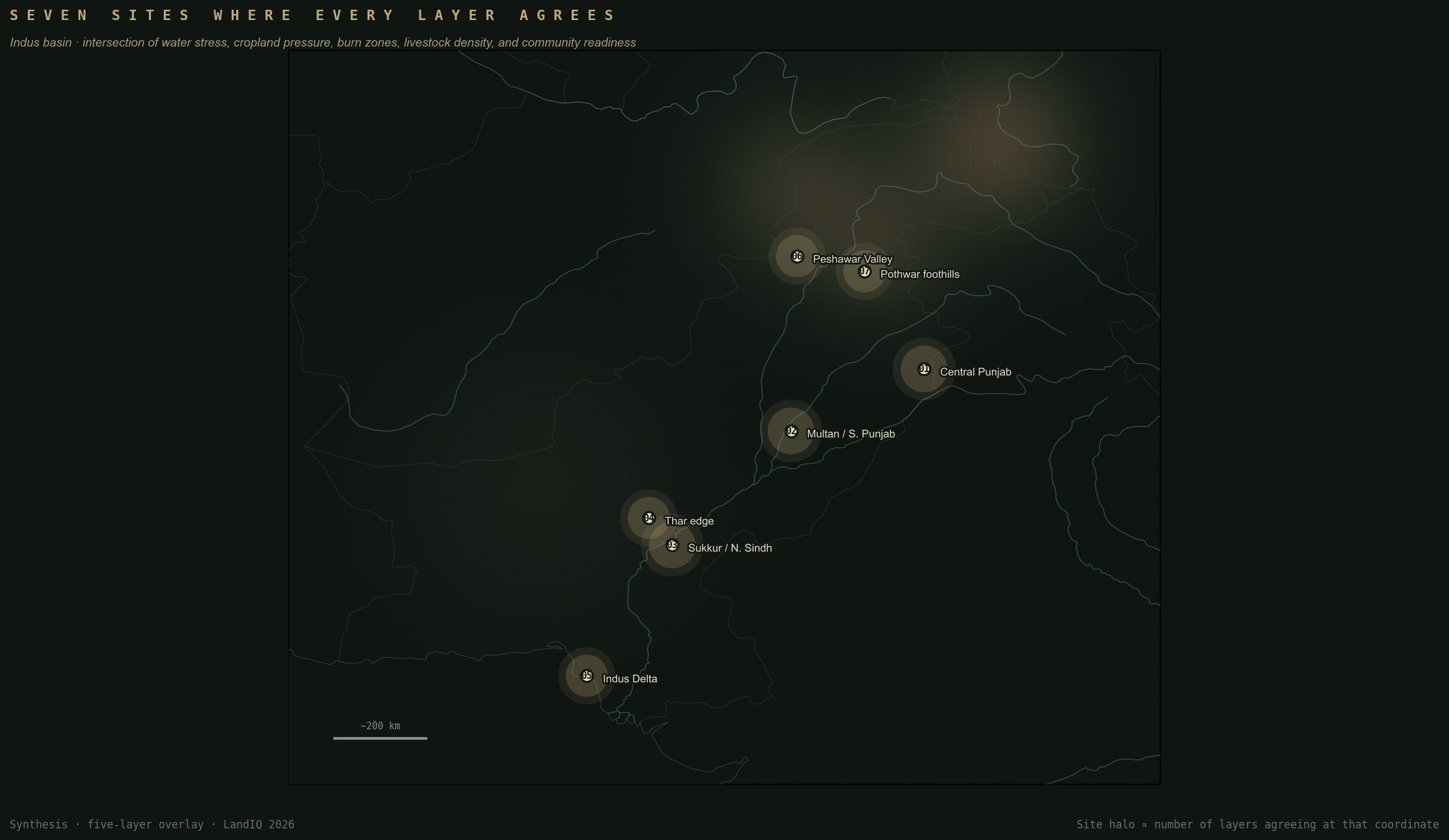
A single pass of the stack surfaces where the basin’s coupling is tight enough to carry a cascade. The deliverable is an optimization — trigger points ranked by leverage per dollar, each with its intervention, its cost, and the positive trajectory it unlocks. Indicative map below; real engagements deepen the layer set, re-weight for the client’s question, and ground-truth every candidate before a dollar is committed.

Seven convergence sites across the Indus basin where water, cropland, burn zones, livestock density, and community readiness overlap
Sample output · LandIQ convergence engine · Indus basin A single-pass run. Candidate districts surface where multiple intelligence layers currently agree. The intervention at each candidate — forest, infiltration, biochar, silvopasture, canal repair — is resolved in engagement, once the stack is weighted for the client's specific question.
How a run works · from question to decision
01 Frame the question. A client arrives with a specific decision — where to site a carbon project, which foothill belt to re-forest first, which canal reach to rehabilitate before the next monsoon. The question decides which of the eight layers carry the most weight.
02 Assemble the stack. The engine pulls the relevant layers at the resolution the question needs — 30 m terrain, 500 m NDVI, 10 km ERA5, district-level census. Common spine: ERA5, GRACE-FO, SMAP, Hansen, Sentinel-1/2, VIIRS, GLW4, WorldPop.
03 Score for cascade potential. Every grid cell gets a score per layer, and a coupling score — how many other layers move when this one is touched. Cells where several layers agree and the coupling is tight rise to the top. These are the trigger points — where a small input propagates furthest.
04 Rank by leverage per dollar. Candidates are ordered not by how much is wrong, but by how far one action travels. Each site carries a projected cascade — water retained, carbon sequestered, yield recovered, flood peak clipped — against its estimated intervention cost.
05 Ground-truth. The top five to ten candidates are narrowed by field visit, drone, and LiDAR where needed. Satellite lies at fine resolution; field closes the gap before any dollar is committed.
06 · DELIVERABLE The leverage map. A ranked list of trigger points with three numbers on each: the intervention, its cost, and the cascade it unlocks — the positive trajectory the coupling will carry once flipped. Not a map of problems. A map of where one dollar carries furthest.
The Stack

Three channels. One synthesis.

Satellite runs always. Field closes the gap satellite can’t resolve. Bespoke answers the question the standing stack wasn’t built for. All three feed the same leverage map.

01 · SATELLITE

Eight layers, always on.

Continuous, audit-grade remote sensing across the full intelligence stack — country or basin scope, repeatable cadence, physics that survives review.

  • InputsERA5 · MODIS · Sentinel-1/2 · Landsat · GRACE-FO · SMAP · Hansen · IMERG · VIIRS
  • CadenceDaily to seasonal composites; alerts when coupling tightens
  • OutputStanding dashboards, monthly convergence runs, GeoTIFF / vector briefs
  • Use whenYou need scale, repeat cadence, and defensible baseline
e.g. monthly LCL-bypass index for the Indus basin, with anomaly alerts during pre-monsoon windows.
02 · FIELD

The resolution satellite can’t reach.

Drone, LiDAR, soil, and acoustic baselines at the sites satellite flags but can’t verify. Closes the gap between 10 m pixels and a foot on the ground.

  • InputsSub-meter photogrammetry · LiDAR canopy scan · soil sampling · acoustic biodiversity · interviews
  • CadenceProject-driven — pre- and post-intervention
  • Output5 cm orthomosaics, biomass & infiltration estimates, calibration datasets
  • Use whenA trigger point is shortlisted and capital is about to commit
e.g. LiDAR canopy scan of a foothill belt with biomass and infiltration estimates before a reforestation tender.
03 · BESPOKE

Your question, modelled.

Custom analysis, modelling, and dataset generation when the standing stack doesn’t answer what you’re defending. Transferable, reproducible, yours.

  • InputsHydrological routing · LCA · biochar kinetics · atmospheric moisture recycling · trigger-point optimisation
  • CadenceEngagement-based — weeks to months
  • OutputMemo + model + dataset — reproducible and transferable
  • Use whenThe question is specific, stakes are high, and physics has to hold up
e.g. modelled cascade of 5% forest-cover restoration on a windward slope across three monsoon seasons, with sensitivity bands.
GovernmentsBasin-scale decision support · physics that survives audit.
MultilateralsOperator partner on country water and climate compacts.
DevelopersPre-MRV site intelligence for carbon and water projects.
NGOsConvergence maps and mechanism grounding on demand.
Field Record

Five countries. One operating pattern.

Pakistan is the flagship — deepest data, longest record, most published. The pattern repeats wherever terrain, water, and land-surface coupling form the primary constraint.

Pakistan
Flagship engagement
Indus basin orographic ladder · ERA5 45-year record · working-paper physics.
Spain
Active fieldwork
Mediterranean hydrology and restoration siting.
Portugal
Active fieldwork
Landscape coupling and restoration diagnostics.
Jordan
Active fieldwork
Arid-zone water intelligence and basin-scale diagnostics.
Colombia
Active fieldwork
Tropical-system restoration and watershed analysis.
Leadership

Ali Bin Shahid

Founder & CEO
Climate & Ecosystem Repair Architect · Regenesis · Ten Lives

Twenty years in systems engineering. A decade on coupled land–atmosphere systems. Peer-reviewed work in hydrology and thermal forcing. Active projects across six countries. LandIQ is the instrument for locating where restoration carries furthest.

  • Peer-reviewed publications in hydrology, thermal forcing, and climate systems
  • Co-author on policy work with Carnegie Europe / Berggruen Institute
  • Active project sites across Pakistan, Spain, Portugal, Colombia, Jordan, and the Arctic

Khurram Irshad

Co-founder & Chairman
Indus Climate Fund · Irshad Foundation · Stony Brook

Entrepreneur with a thirty-year track record of executing first-of-kind projects in industry and capital — from a patented textile-wastewater reuse process (PK 139309, 2007) to leadership of the Indus Climate Fund in New York, directing catalytic capital into climate technology, sustainable agriculture, biochar, and carbon markets. Trustee of the Irshad Foundation for nineteen years, financing girls’ education across rural Sindh. Stony Brook University. Anchors LandIQ’s operational scale, client relationships, and long-term direction as the practice moves from consulting to platform.

Belief

Every degraded landscape contains the map of its own recovery. The coupling that drove collapse is the same coupling that carries restoration. The question was never whether recovery is possible. It was always: where do you start?

Schedule

Consulting now. Platform in 2027.

Today, each engagement is bespoke. The pipeline that backs them becomes a product once the pipeline is proven.

Now

Consulting & Project Analysis

Spatial intelligence assembled per-project. Satellite-based analysis, convergence reports, strategic plans, and advisory engagements across water, agriculture, and restoration.

Next · Late 2026

Data Pipeline

Automated ingestion from satellite, government, and field sources. Convergence scoring validated against live deployment outcomes. Bioacoustic biodiversity layer in development.

Horizon · 2027

SaaS Platform

Self-serve access. Query any district. Export convergence reports. API for MRV integration, carbon registries, and project developers.

Every district has a first site. Let us find yours.

We work with organizations, governments, and investors who want their next intervention to land at the site where one action carries five outcomes.

ali@landiq.earth